
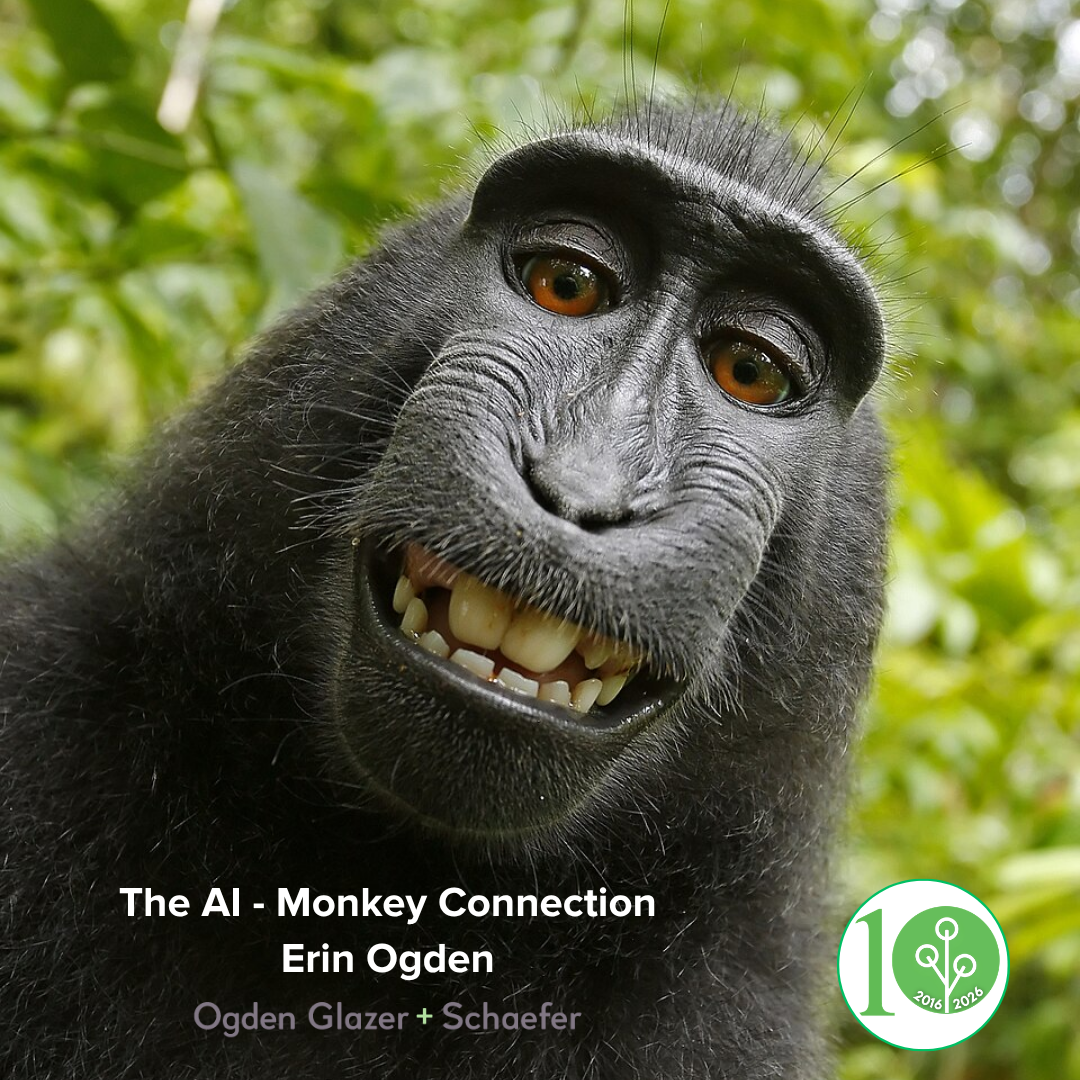
U.S. copyright law protects works created by humans. The Copyright Office will not register content produced entirely by a non-human source. Courts have applied this rule to works attributed to animals, supernatural beings, and natural forces. Not monkeys, not oceans, not even “celestial beings” can own a US copyright. Courts found Naruto the monkey couldn’t protect his “selfie” even though he was smiling oh so handsomely. The also found that the Urantia Foundation couldn’t register a book that they claimed to be “authored by celestial beings and transcribed, compiled and collected by mere mortals.”
The same principle applies to material created solely by artificial intelligence. In Thaler v. Perlmutter, the federal courts confirmed content generated solely by AI is not protected.
Now you may have noticed the gap. How much human involvement is sufficient in order to get protection? Right now, we can only provide a big fat shrug and our best guess. A pending dispute in Colorado involving an image developed through more than 600 prompts illustrates that the answer is still evolving. Right now, we can be sure that purely AI-generated output is unprotected and more interaction may allow protection. But how much? <Shrug> If you do more than click OK to what is suggested after a simple prompt, document the human creative decisions behind the AI-assisted work. Show it was a tool to express your creativity and your decisions. And don’t let Naruto steal the spotlight.