
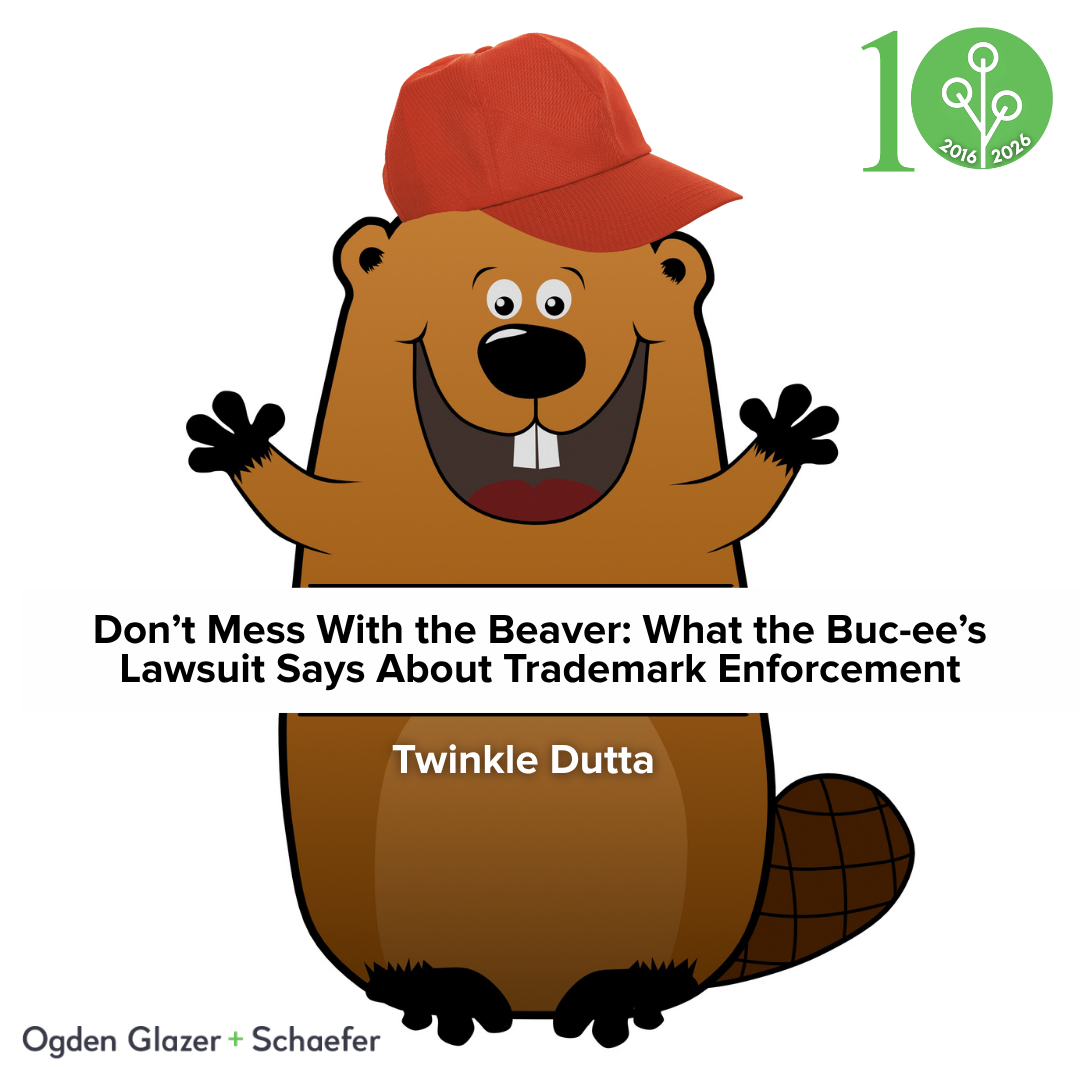
Think of all the travel centers you know. Now, think of which one of those has the largest convenience store with 75,593 square feet. If you still cannot figure it out, think of the smiling beaver wearing a red hat with a yellow circular background. You guessed it, we are going to talk about Buc-ee’s!
Buc-ee’s is a cultural phenomenon that, despite having over 50 locations and spanning over 12 states, has a legal team that actively monitors and enforces its trademarks. Even though there is such strong customer recognition for Buc-ee’s logo and brand, its commercial value warrants active trademark enforcement protection. Overall, it is your responsibility as a trademark owner to bring any legal action to stop a party from using an infringing trademark.
Recently, Buc-ee’s has been in the media for filing two lawsuits against potential trademark infringers: Mickey’s and Teddy’s Stores. In their trademark infringement complaint against Mickey’s, Buc-ee’s alleged that Mickey’s “logos incorporate a cartoon animal facing right with wide eyes and a smile, overlaying a round background” and therefore it “closely resembles [Buc-ee’s] distinctive logos.” The lawsuit centers on Mickey’s rebranding from “Mickey Mart” to “Mickey’s” along with an updated logo that Buc-ee’s believes more closely resembles its own.
Similarly, in their lawsuit against Teddy’s, Buc-ee’s alleged that Teddy’s brand identity may cause confusion among consumers because its brand “prominently features an anthropomorphic and cartoon representation of a smiling animal that closely resembles a beaver, wearing a hat, with white specular highlights on its eyes, with a solid black nose with a single white specular highlight, showing a glimpse of a red/pink tongue, and with lighter coloration around its mouth, in at least some examples being encased in a contrasting geometric shape.” The suit even breaks down the names: both “Buc-ee’s” and “Teddy’s” are two-syllable, six-letter possessives ending in an “eez” sound and calls the resemblance deliberate.
Although Buc-ee’s, Mickey’s, and Teddy’s each use a smiling cartoon animal in their branding and logos, they are different animals. However, the question of whether consumers may be confused between the three animals, leading to infringement, is one for the courts. The outcomes of these lawsuits will shed light on whether Buc-ee’s is too aggressively enforcing its trademark rights or just appropriately doing so. Either way, this is something to look out for when considering if a competitor is infringing on your trademark and the importance of enforcing your rights. Trademark enforcement is a vital component of protecting brand identity and preventing consumer confusion regarding similar marks in the marketplace.
Key Takeaways for Trademark Owners:
How to protect your trademark? There are several ways to protect your trademark, of which some of the most effective tactics are through trademark registration, trademark monitoring, trademark enforcement, and abandonment avoidance.
What is trademark monitoring? It is regularly monitoring the marketplace for unauthorized uses of your trademark via online platforms, trademark searches, and watching for potential infringements within the industry.
What is trademark registration? It is registering your trademark with the U.S. Patent and Trademark Office (USPTO), which provides enhanced legal protection. A registered trademark gives you the ability to enforce your rights in federal court and can stop the importation of counterfeit goods.
What is trademark enforcement? It is taking action to stop trademark infringement once it has been identified. This involves sending cease-and-desist letters, negotiating settlements, or even pursuing litigation to protect your rights.
What is the avoidance of abandonment? Trademark abandonment occurs if trademarks are not actively being used or enforced. Exclusive rights may be maintained through continuous use in commerce along with consistent enforcement.
Protecting and enforcing your trademark rights is critical to maintaining your brand’s value, reputation, and distinct identity in the marketplace. As a trademark owner, you should enforce your trademark rights to protect the life of your trademark.